Does Birthplace Diversity Affect Economic Complexity? Cross-country Evidence
Dany Bahar, Hillel Rapoport, Riccardo Turati
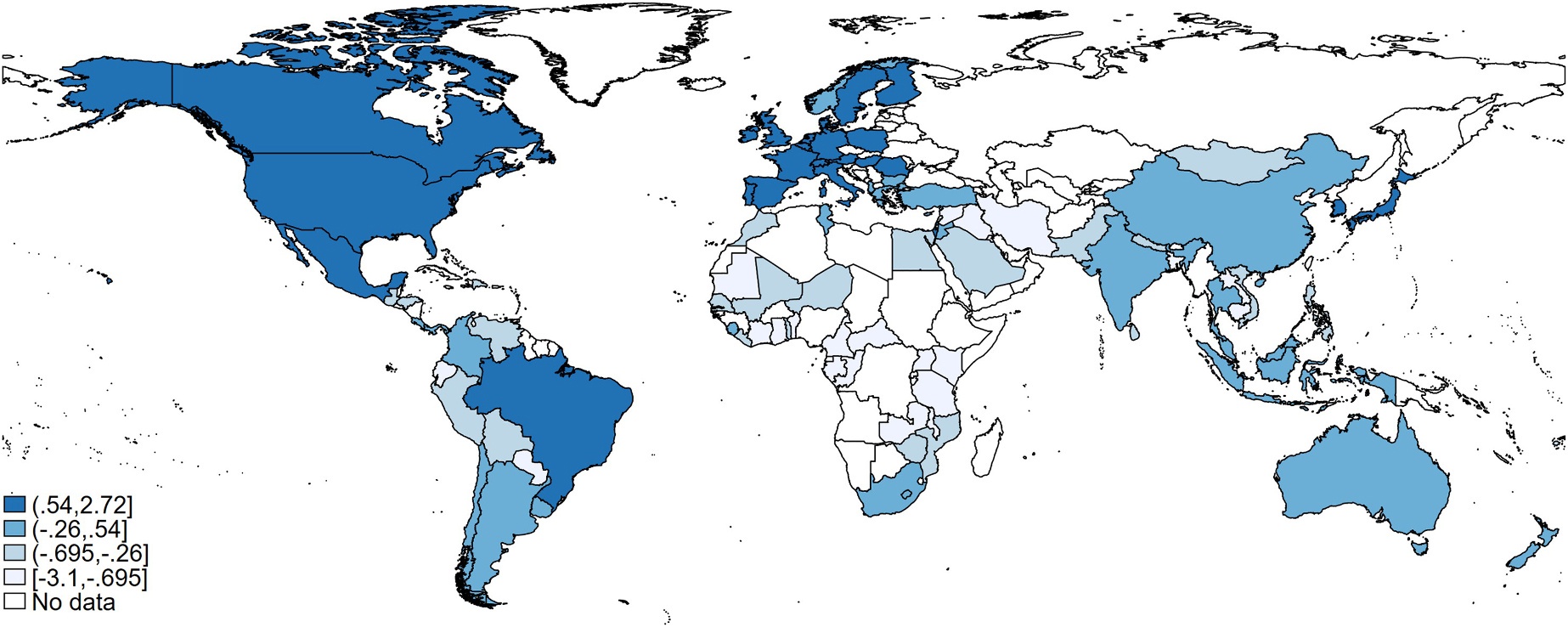
Key Findings
- Countries with one standard deviation higher birthplace diversity exhibit 0.1 to 0.18 standard deviations higher economic complexity
- The effect is strongest for diversity among college-educated migrants, consistent with skill complementarity driving the relationship
- Results are particularly strong for developing countries at intermediate levels of economic complexity—diversity matters most where there's room to grow
- The positive relationship is driven by diversity from new origin countries (extensive margin), suggesting the introduction of genuinely new skills and knowledge
- Birthplace diversity affects complexity primarily through export basket diversification, not through making existing products less ubiquitous
About This Research
Can immigration-driven diversity help countries develop more sophisticated economies? This paper investigates the relationship between the diversity in the birthplaces of a country's immigrants and its level of economic complexity—a measure that captures a nation's accumulated productive capabilities reflected in the sophistication and diversification of its export basket.
The dominant interpretation for why birthplace diversity boosts economic performance has to do with skill complementarity: immigrants who grew up in different environments, went to different school systems, and learned different trades bring complementary knowledge that expands a country's ability to compete in a broader set of economic activities. We put this theory to the test using bilateral migration data for 100 countries over 1990-2000, combined with the Economic Complexity Index.
To address endogeneity concerns—more complex economies might simply attract more diverse immigrants—we employ two instrumental variable strategies: a pseudo-gravity model predicting bilateral migration stocks and a shift-share approach using 1970s migration settlement patterns. Both methods support a causal interpretation. The mechanism appears to operate through export diversification: birthplace diversity expands the range of products a country exports competitively, rather than making existing exports less ubiquitous.
Related Research
The Impact of Immigrant Talent on Global Product Strategy
Management Science, 2026
Legalizing Entrepreneurship: Evidence from a Formula Instrument Design
The Economic Journal, 2026
Sanctions on Venezuela Are Not Driving Migration to the Southwest Border: An Empirical Assessment
Economía LACEA Journal, 2026