Not a Border Crisis, but a Labor Market Crisis: The Often Overlooked Pull Factor in US Border Crossings
Dany Bahar
A published correction for a minor coding error and a clarification note on the cointegration test statistic accompany this paper.
Key Findings
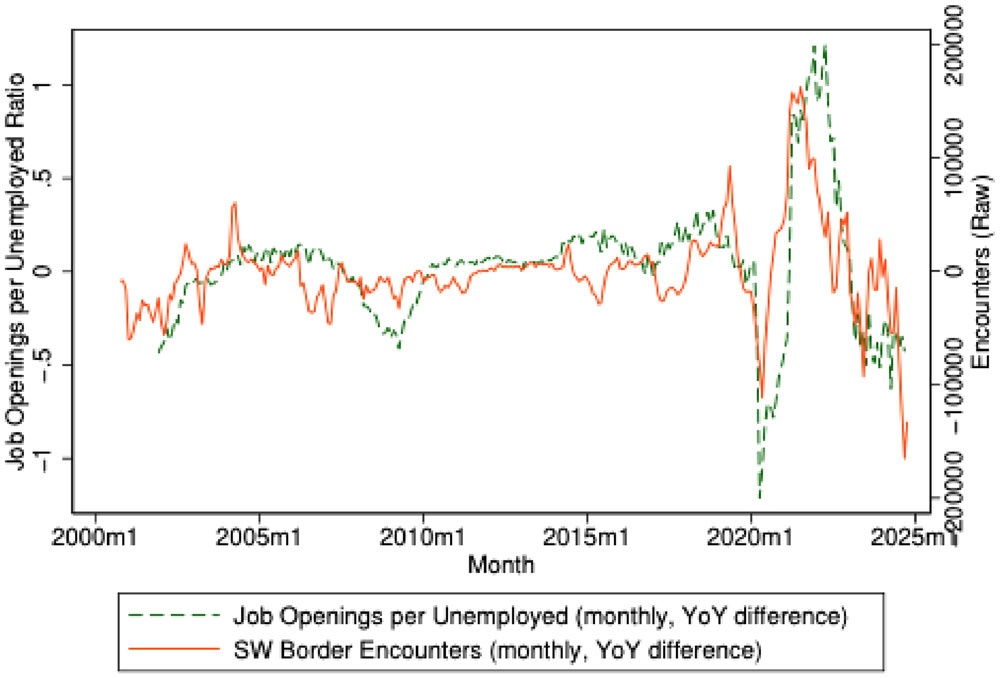
- A 10% increase in labor market tightness is associated with a 3.5-7.3% increase in border crossings, depending on the estimation approach
- The relationship between border crossings and labor market tightness shows no statistically significant differences across presidential administrations (Bush, Obama, Trump, Biden)
- Border crossings naturally decrease as the labor market cools—which is what occurred during 2024 as labor market tightness eased
- The surge in border crossings in 2022-2023 would likely have occurred at a similar magnitude regardless of which party occupied the White House, given the unusually tight labor market
About This Research
In an era where migration policies and border security dominate political debates, understanding the dynamics of border crossings requires a nuanced examination of the economic conditions that drive such movements. This study delves into the pivotal role of labor market tightness—the ratio of job openings to unemployed persons—in shaping patterns of border crossings over nearly a quarter century.
The analysis reveals that what is often perceived as a 'border crisis' is, in many respects, a manifestation of the U.S. economy's labor demands. The comovement between border crossings and labor market tightness is particularly pronounced during years when both reached all-time highs. Crucially, during those same years, there was no particular economic shock in migrant-sending countries of an order of magnitude that could explain the rapid increase in crossings.
These findings have significant implications for the discourse on migration policy. By demonstrating the critical importance of economic 'pull' factors, the study challenges the prevailing policy focus on enforcement and assistance to migrant-sending countries as the primary means of reducing irregular border crossings. The provision of legal pathways to satisfy labor market demands should be part of the solution.
In the Press
- Bloomberg — Harris Didn't Fail Her Border Task. But Did She Succeed?
- ProPublica — The New Effects of Immigration
Related Research
The Impact of Immigrant Talent on Global Product Strategy
Management Science, 2026
Legalizing Entrepreneurship: Evidence from a Formula Instrument Design
The Economic Journal, 2026
Sanctions on Venezuela Are Not Driving Migration to the Southwest Border: An Empirical Assessment
Economía LACEA Journal, 2026