Migration, Knowledge Diffusion and the Comparative Advantage of Nations
Dany Bahar, Hillel Rapoport
Key Findings
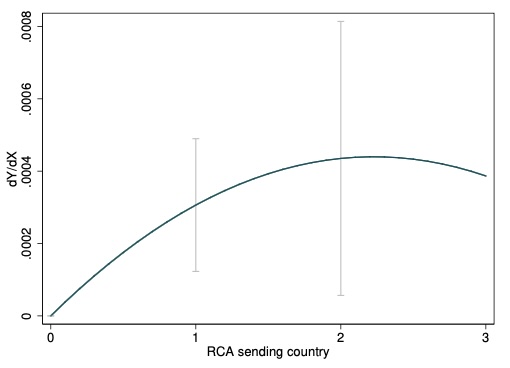
- Countries with larger immigrant populations from product-exporting nations are more likely to export those same products
- The effect is stronger for complex products requiring tacit knowledge rather than standardized goods
- A doubling of immigrants from a product-exporting country increases the probability of developing comparative advantage by 25%
- The knowledge transfer effect persists even when controlling for trade, FDI, and geographic factors
About This Research
Why do some countries become competitive exporters of certain products while others never develop those capabilities? Traditional trade theory emphasizes factors like natural resources or capital accumulation, but this paper demonstrates that migration plays a crucial and underappreciated role in shaping countries' comparative advantages.
We examine detailed data on bilateral migration stocks and export patterns for over 100 countries. The key finding is remarkable: countries are significantly more likely to develop export competitiveness in products where their immigrant populations have productive experience. When a country receives migrants from places that already export a particular product, that country becomes more likely to start exporting the same product itself.
This evidence suggests that migrants carry tacit productive knowledge—the kind of 'know-how' that cannot easily be transferred through manuals or formal education. Our findings have profound implications for understanding economic development and the benefits of immigration: migrants don't just fill jobs, they transfer knowledge that can reshape entire industries and help countries climb the development ladder.
In the Press
- Project Syndicate — The Diaspora Goldmine
- VoxDev — Let their people come: Migrants as drivers of knowledge diffusion
Related Research
The Impact of Immigrant Talent on Global Product Strategy
Management Science, 2026
Legalizing Entrepreneurship: Evidence from a Formula Instrument Design
The Economic Journal, 2026
Sanctions on Venezuela Are Not Driving Migration to the Southwest Border: An Empirical Assessment
Economía LACEA Journal, 2026