Neighbors and the Evolution of the Comparative Advantage of Nations: Evidence of International Knowledge Diffusion?
Dany Bahar, Ricardo Hausmann, César A. Hidalgo
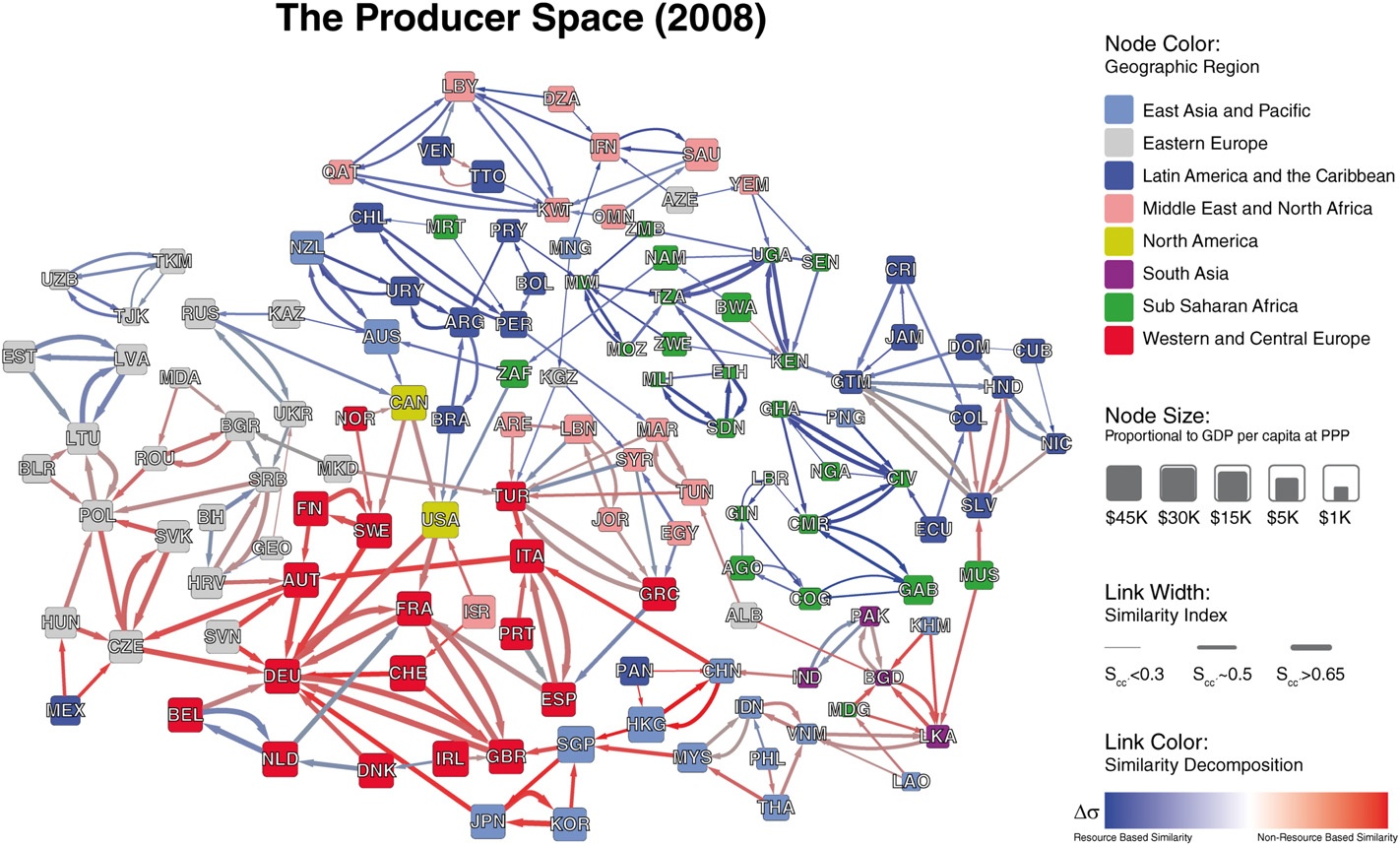
Key Findings
- Countries are 50-100% more likely to develop export competitiveness in products exported by their neighbors
- The effect decays with distance but remains significant even for non-contiguous countries in the same region
- Knowledge spillovers are strongest for complex manufactures rather than commodities
- The effect operates independently of formal trade agreements or colonial history
About This Research
Geography matters for economic development in ways that go beyond natural resources and trade costs. This paper presents evidence that countries tend to develop export capabilities in products that their geographic neighbors already produce, suggesting that proximity facilitates the diffusion of productive knowledge across borders.
We analyze the evolution of export patterns for over 130 countries spanning four decades. The key finding is that after controlling for all standard determinants of trade, a country is significantly more likely to start exporting a product if its neighbors already export that product. This 'neighbor effect' cannot be explained by shared geography, similar factor endowments, or trade agreements—it points to knowledge spillovers.
The implications are significant for understanding economic development. Countries don't develop in isolation; they learn from their neighbors. This explains why successful industries often cluster geographically and why regional development initiatives may be more effective than isolated national strategies. For policymakers, the findings suggest the value of regional cooperation and the importance of being connected to successful economic neighbors.
Related Research
Migration and Knowledge Diffusion: The Effect of Returning Refugees on Export Performance in the Former Yugoslavia
Review of Economics and Statistics, 2024
Innovation on Wings: Nonstop Flights and Firm Innovation in the Global Context
Management Science, 2023
Refugees, Trade, and FDI
Oxford Review of Economic Policy, 2022